



A new report from Rockwell Automation has found that while manufacturing execution system (MES) adoption is now widespread, most manufacturers are still struggling to integrate and scale the technology across their organisations.
Enterprise-wide MES integration remains a key challenge
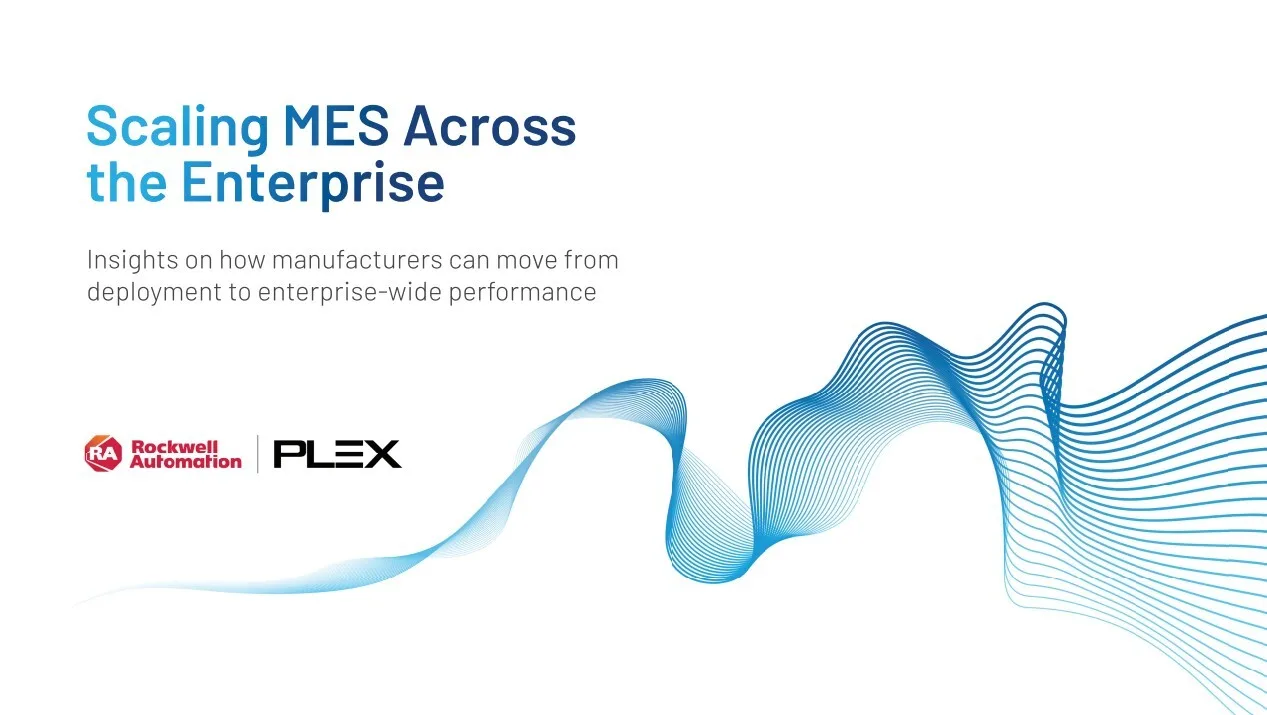
The report, Scaling MES Across the Enterprise, is based on responses from 1,560 manufacturing and industrial operations decision-makers across 17 countries. It highlights the gap between initial MES deployment and enterprise-wide integration, identifying disconnected systems, underused data and operational risk as barriers to achieving greater value from existing investments.
MES adoption outpaces enterprise deployment
According to the report, 93% of manufacturers have implemented MES in at least one facility. However, only 28% have deployed MES across the enterprise, while just 23% report full integration with Enterprise Resource Planning (ERP), Product Lifecycle Management (PLM), quality and operational technology (OT) systems.
The findings suggest that manufacturers have largely moved beyond adopting MES but continue to face challenges in scaling deployments consistently across multiple sites.
Integration remains the biggest priority
Integration emerged as both the leading purchasing requirement and the biggest modernisation challenge.
The report found that 44% of respondents ranked integration as their top MES buying requirement, while 33% identified MES as their biggest data integration challenge.
AI ambitions depend on better data
Manufacturers expect artificial intelligence to support 42% of manufacturing processes within the next year, increasing to 54% by 2030.
However, the report also found that 43% of manufacturers do not believe they are using the data they collect effectively, despite data being fundamental to AI deployment.
Cybersecurity influences MES investment
Operational resilience is becoming an increasingly important consideration for manufacturers investing in MES.
According to the research, 46% of manufacturers experienced a cyber incident during the past year, while 43% cited security and compliance as the second most important MES purchasing requirement.
Customer expands MES deployment
The report highlights Kumi North America, a Tier one automotive supplier specialising in injection-moulded interior plastics and assemblies, as an example of an organisation expanding its MES deployment.
The company first implemented Plex in 2008 and has since deployed the software across facilities in the United States and Canada. It has also expanded its use of Plex MES Automation & Orchestration (MES A&O).
“Before Plex, our operations struggled to synch and some locations didn’t have any software,” shared Paul Andrews, assistant vice president of systems, Kumi North America. “Our Plex infrastructure has grown alongside Kumi’s expanding business, and we’ve continued to leverage Plex technology in new ways.”
Focus shifts from adoption to scale
Anthony Murphy, vice president of product management, Rockwell Automation, said manufacturers are now focused on extending the value of MES across their operations.
“MES adoption is no longer the hurdle, but enterprise scale is,” said Anthony Murphy, vice president of product management, Rockwell Automation.
“Manufacturers may have checked the box by making initial investments in MES technology, but many struggle to gain full value across the enterprise. The impact of a MES has also changed—it’s shifted from production tracking to providing insights across a company’s full operations, like quality management, worker productivity and supply chain forecasting.
Additionally, when connectivity is actualized, there are more opportunities to leverage AI technology. Manufacturers winning the race are not doing more than the rest, they’re just doing more together. With an elastic, edge-to-cloud MES like Plex, manufacturers can connect all aspects of production right away and then scale however they want over time.”
Lorenzo Veronesi, associate research director, IDC, said organisations risk missing the full benefits of MES if integration challenges remain unresolved.
“Manufacturers have moved past the question of whether to adopt MES and are now confronting the harder challenge of scaling it,” said Lorenzo Veronesi, associate research director, IDC. “With integration ranking as both the top buying requirement and the leading modernization challenge, organizations risk leaving significant value on the table if disconnected systems and underutilized data go unaddressed.”
Report methodology
The research is based on responses from 1,560 hardware, software and services decision-makers working in manufacturing and industrial operations across 17 manufacturing countries.
Respondents represent discrete, process and hybrid industries. More than half (58%) work for organisations with annual revenue exceeding $1 billion, while 54% are primary decision-makers.
This article was produced by the editorial team at Manufacturing Outlook and published as part of the Outlook Publishing global network of B2B industry magazines.
Outlook Publishing delivers industry insights, company stories, and sector coverage across manufacturing, mining, construction, healthcare, supply chains, food production, and sustainability.
Manufacturing Outlook provides ongoing coverage of organisations and developments shaping the global manufacturing industry.