



Rising energy costs do not create a trade-off with sustainability goals. Rather, they crystallise the business case for target achievement. This case rests upon near-term energy operational expenditure (OpEx) reductions and long-term insulation from energy price volatility and climate regulations.
Manufacturers who haven’t maxed out efficiency improvements should seize this opportunity immediately. Higher energy costs shorten payback periods, pushing more sustainability projects past hurdle rates. If capital budgets are constrained, energy service contracts can transfer performance risk whilst delivering immediate savings. Operational changes identified through retro-commissioning or audits provide OpEx savings without capital. A revolving fund replenished by these savings creates a flywheel for future sustainability investment and growing OpEx savings.
Manufacturers who have already exhausted the low-hanging fruit should focus on hedging future price and regulatory risks. A manufacturer currently meeting sustainability targets through unbundled renewable energy certificates can shift to a long-term renewable power purchase agreement to lock in rates. Similarly, investments in the energy transition, from process electrification to incentivising supplier decarbonisation, mitigate future fossil-fuel price shocks to both energy costs and product inputs. These also reduce regulatory carbon pricing risk.
The real question to ask is what barriers prevented your organisation from taking these actions already?
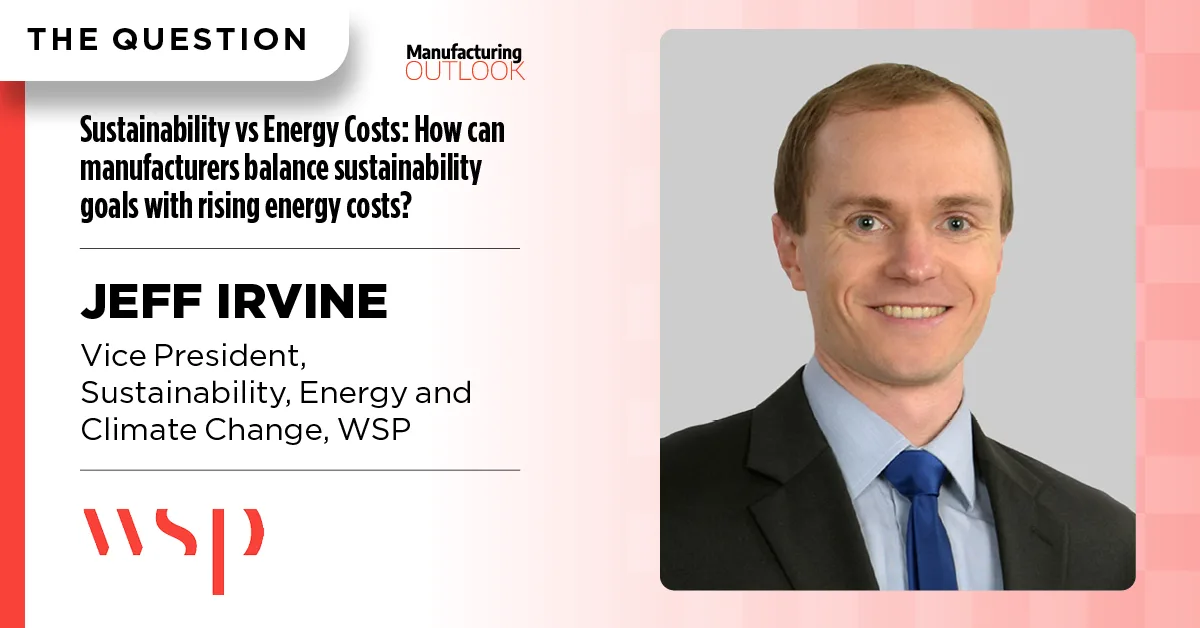
Jeff Irvine
Vice President, Sustainability, Energy and Climate Change, WSP
About Jeff Irvine
Jeff Irvine has 19 years of experience implementing sustainability policy and programme management solutions for corporations and city governments. Irvine leads the SECC Net Zero Strategy Domain, advising numerous Global 500 companies on science-based target setting, climate transition planning, and activating sustainability strategy implementation.
About WSP
WSP is one of the world’s leading professional services firms, uniting its engineering, advisory and science-based expertise to shape communities to advance humanity.
The Question is a thought leadership series published on Manufacturing Outlook, created to explore the questions shaping global production, industrial innovation, automation, and operational excellence.
Manufacturing Outlook features leadership insights and company stories from organisations driving progress across manufacturing, engineering, automotive, aerospace, maritime, and advanced industrial sectors.
Produced as part of the Outlook Publishing global network of B2B industry magazines, The Question brings focused executive insight to audiences engaged with the companies, technologies, and decisions shaping the future of manufacturing.