




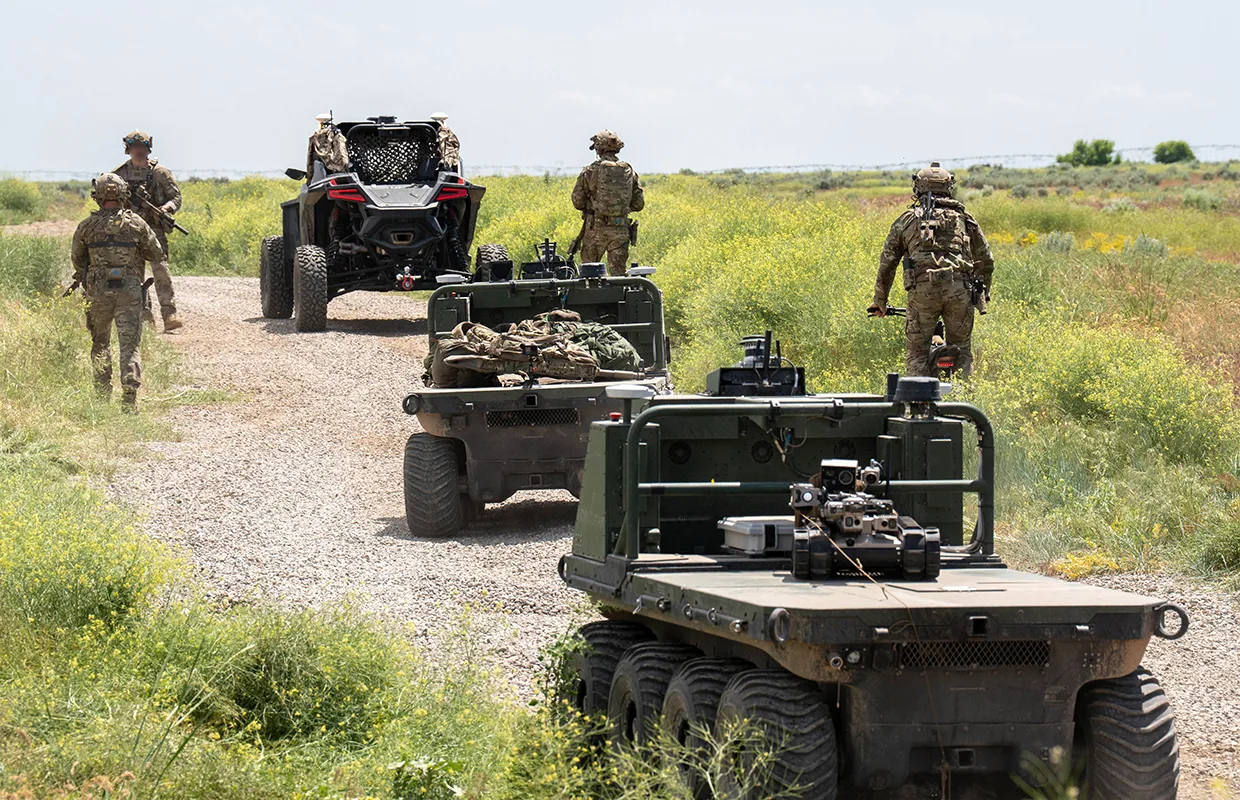
We dive into Forterra’s innovative spirit with insights from its executive team, exploring how the company’s mission-driven ethos is transforming the battlefield into a realm where technology meets tenacity.
FORTIFYING THE FUTURE FRONTIERS OF DEFENSE
In a world where the dynamics of warfare are ever-evolving, Forterra stands at the cutting edge, redefining what it means to be a leader in autonomous defense solutions.
Headquartered in Clarksburg, Maryland, with additional offices in Arlington County, Virginia; Winter Park, Florida; Ketchum, Idaho; and Palo Alto, California, the company boasts over 500 employees who are pushing the boundaries of defense technology.
The future of mission autonomy is not just a vision for Forterra, it’s a reality, providing advanced modular solutions designed for independent operation or seamless integration.
This enables multiple vehicles to operate autonomously, with the ability to allow an operator to intervene, if necessary, to ensure resilience and mission intent in challenging environments.
“From self-driving land systems to robotic swarms, we create scalable, robust hardware and software platforms that enable our customers to utilize autonomy effectively, enhancing reach, survivability, and mission success,” proudly introduces Josh Araujo, CEO.
“Our mission is warfighter-focused; we develop technology that minimizes risks for those who serve. With a high concentration of veterans on our team, we understand the challenges and gaps faced in combat.”
Forterra specializes in key technologies, differentiating its products through unique platforms and systems that set it apart in the market. These comprise modules for compute, data, communications, mobility, and sensing, enhancing defense capabilities while prioritizing warfighter safety on the battlefield.
“We focus on creating autonomous systems that function in real-world, off-road environments. For example, our core platform, AutoDrive, is designed to operate in unpredictable conditions without relying on perfect maps, adapting in real time to rough terrain, dynamic obstacles, and degraded GPS environments,” he details.
“Moreover, Vektor is an edge-deployed, software-defined communication and smart data-brokering layer designed for operations in disrupted, degraded, intermittent, and low-bandwidth environments. It enables real-time data flow and situational awareness across autonomous, manned, and hybrid vehicles, even when disconnected or GPS-denied.”
However, unlike conventional systems that require constant, high-quality network access, Vektor maintains data and command flows without it.
“To enhance resilience, we acquired the mobile mesh networking company goTenna in 2025. All these solutions operate concurrently on Fabric, our integration layer that allows communication with third-party software and hardware,” explains Araujo.
This is significant because Fabric offers an open software architecture for plug-and-play interoperability across vendors and platforms, ensuring seamless interoperability among autonomous systems, payloads, and command and control (C2) infrastructure.
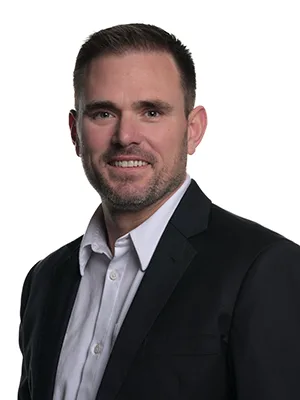
“Our mission is warfighter-focused; we develop technology that minimizes risks for those who serve. With a high concentration of veterans on our team, we understand the challenges and gaps faced in combat”
Josh Araujo, CEO, Forterra
INNOVATING AT AN INTERSECTION
Although each Forterra product has unique features, the company’s main differentiator is its proven and actively deployed solutions.
“Many companies remain in R&D or prototyping, but in the national security sector, real-world deployment with the US Department of War (DoW) is where impact is made,” Araujo outlines.
“Forterra has been the DoW’s leading autonomy provider across numerous ground programs, with our products in active use in combat zones worldwide. In this field, it’s clear: you’re either proven and deployed or you’re not.”
The company’s approach to R&D involves pairing two perspectives: deep technical expertise and direct operational experience; bringing together engineers who understand what is technically possible with former operators who understand the demands of missions in the field.
“The intersection of engineers and operators is where true innovation occurs. Focusing solely on technology may lead to capabilities in search of a problem, while concentrating only on the mission risks means missing new solutions to longstanding challenges,” Scott Philips, Chief Innovation Officer, imparts.
Forterra’s R&D philosophy focuses on aligning mission needs with technical maturity to provide robust, deployable capabilities relevant to modern conflict.
One area where that approach is especially visible is the company’s work with the electromagnetic spectrum.
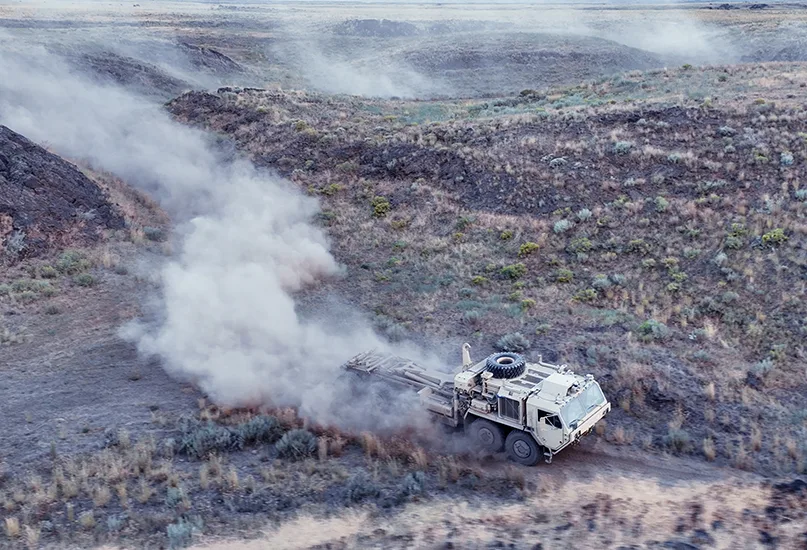
“In modern conflict, the spectrum is both a vulnerability and an opportunity. We are enhancing our autonomous infrastructure, sensors, compute, and radios to optimize communications and increase awareness of adversary activity.
“By developing techniques to map the radio frequency (RF) environment dynamically, we can reposition assets to create the optimal geometry needed to support mission objectives,” Philips states.
Additionally, Forterra’s innovation strategy centers on technologies that enhance edge autonomy and resilience in denied environments, improving operators’ awareness and control during critical situations.
By leveraging artificial intelligence (AI)-driven software, the company boosts operational efficiency, allowing small teams to process data beyond human limits, leading to quicker, more informed decisions and greater force multiplication.
Combining technical expertise with operational experience means Forterra’s mature technologies offer real advantages in the contested environments of modern conflict.
“We focus on maintaining resilient C2 infrastructure in the electromagnetic spectrum, optimizing communications and adversary awareness. Our innovation agenda emphasizes autonomy, resilience in denied environments, and enhanced operator adaptability in critical situations,” urges Philips.

“It’s crucial for defense technology to provide emerging systems for large-scale, long-term use, rather than just pilot programs, to validate the new operating models with autonomous systems”
Scott Sanders, Chief Growth Officer, Forterra
COLLABORATIVE STRATEGIES
The most significant challenge facing the industry is not technological but structural.
“There is often a persistent institutional tendency to pursue the most technically sophisticated solution rather than the most deployable one,” voices Scott Sanders, Chief Growth Officer.
In general, the defense sector is now more willing to expedite the prototyping of new technologies. The DoW has vigorously worked to secure initial access to the Pentagon and has invested significantly in emerging companies.
“The journey to secure scalable production contracts often highlights successful prototypes that struggle to transition to practical use. A significant increase in efforts is needed to facilitate this process and deploy new technologies en masse.
“It’s crucial for defense technology to provide emerging systems for large-scale, long-term use, rather than just pilot programs, to validate the new operating models with autonomous systems,” Sanders discusses.
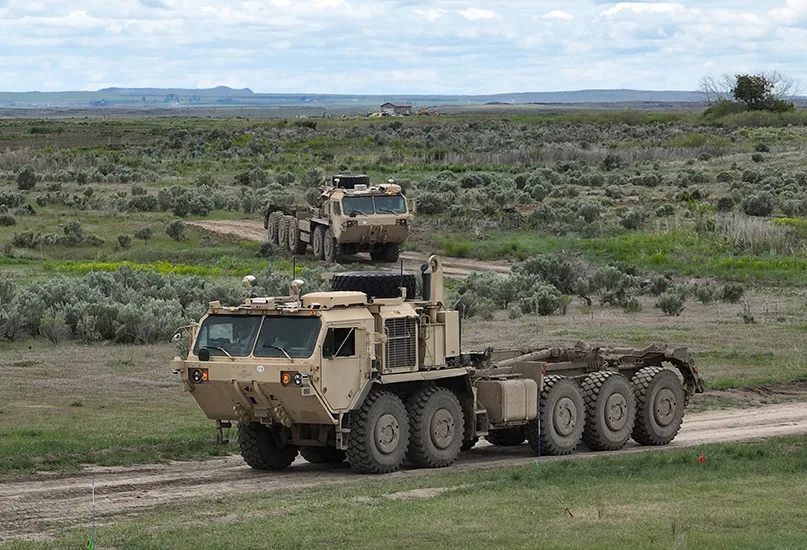
Forterra’s partnership strategy emphasizes an open, interoperable platform that incorporates top-tier capabilities rather than developing everything internally, and collaborations with Aeva and Nominal exemplify this approach.
As such, Forterra has integrated 4D light detection and ranging (LiDAR) technology into the AutoDrive platform with Aeva, allowing for simultaneous detection of velocity and position.
This capability ensures high-resolution awareness in challenging conditions, which is essential for autonomous vehicles operating in GPS-denied environments.
Equally important is the partnership with Nominal, which addresses the need for robust testing and validation as Forterra scales production for US Army and Marine Corps programs.
“Nominal offers a unified data platform that supports consistent regression testing and fleet analytics, ensuring anomalies are swiftly identified and resolved, thereby aiding program timelines and delivery confidence,” acknowledges Sanders.
These partnerships aim to ensure every layer of the stack meets the standards for autonomous systems in demanding environments.
“We’ve also teamed up with both emerging technology companies and traditional defense primes like RTX and BAE Systems, believing that the warfighter needs both to succeed,” says Sanders.

“Building systems that meet certain standards at production scale for the US military is an extraordinary engineering challenge, and Forterra has been doing this for 20 years”
Scott Philips, Chief Innovation Officer, Forterra
SETTING STANDARDS AND NAVIGATING FRONTIERS
The ethical framework for autonomous systems in defense begins with a principle that many in the industry stand by, there will always be a human in the loop.
These systems, however capable, are intended to enhance human decision-making rather than replace it.
“Autonomy improves information processing, lessens cognitive load, and safeguards personnel. Human accountability in the use of lethal force is essential. As autonomous systems evolve, human oversight must keep pace.
“The key question is whether these systems provide meaningful human authority at critical moments. Transparent, auditable, and interruptible designs can ensure this,” Philips reinforces.
Furthermore, companies operating in this space have a broader obligation to engage this question seriously and early enough, rather than treating it as a compliance exercise.
“Technology is advancing faster than the policy frameworks designed to govern it, placing real responsibility on the developers and operators of these systems to help define what responsible use looks like,” he continues.
Developing and scaling ground-based autonomy is particularly challenging, especially in the battlefield domain. According to Philips, this complexity makes the work compelling.
“Building systems that meet certain standards at production scale for the US military is an extraordinary engineering challenge, and Forterra has been doing this for 20 years.”
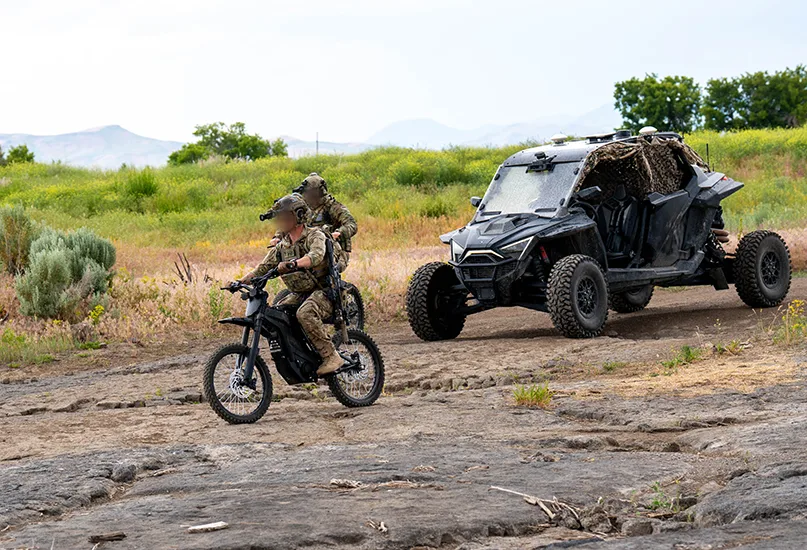
Moreover, the company is continuing to invest heavily in the development of integrated combat systems.
“We’re focused on filling gaps and expanding our capabilities while developing new solutions based on demand,” Sanders points out.
“As Forterra has grown rapidly this past year, we’re committed to hiring the right people and forming partnerships to ensure our infrastructure supports our growth, which for us is about readiness, not just size.”
Meanwhile, the company’s number one priority remains being a strong and reliable partner to the DoW.
“We will continue to show up consistently, fulfill our commitments, and ensure the solutions we provide effectively address the real problems faced by warfighters in the field. You can’t ignore what’s happening on the global stage right now. There’s a lot of conflict, and that’s a sobering reality, but it also reinforces why this work matters.
“We hope to play a bigger role in protecting American soldiers wherever they’re deployed, ensuring they have the tools, connectivity, and support they need to return home safely. That’s what drives us; everything else follows from that,” Araujo inspiringly concludes.
In a rapidly changing world, Forterra isn’t just keeping pace. It is setting the standard for what’s possible in defense technology by actively shaping its future.
This company profile was produced by the editorial team at Manufacturing Outlook, a publication within the Outlook Publishing global network of B2B industry magazines.
Outlook Publishing showcases organisations and leadership teams shaping sectors including manufacturing, mining, construction, healthcare, supply chains, food production, and sustainability.
Manufacturing Outlook explores the companies, technologies, and leaders transforming the global manufacturing sector.